Improper Greasing Ruining Bearings? Unveiling the Lubrication Pitfalls Trapping 90% of Maintenance Staff
From: XingMao DATE: 2026/7/20 Hits: 3512
Improper Greasing Ruining Bearings? Unveiling the Lubrication Pitfalls Trapping 90% of Maintenance Staff
In the field of equipment maintenance, bearing greasing is often viewed as a simple, routine task. Yet, this seemingly trivial activity harbors numerous critical errors. Statistics show that many cases of premature bearing failure stem not from quality issues, but from improper lubrication. To ensure the long-term, stable operation of equipment, we must re-e...
In the field of equipment maintenance, bearing greasing is often viewed as a simple, routine task. Yet, this seemingly trivial activity harbors numerous critical errors. Statistics show that many cases of premature bearing failure stem not from quality issues, but from improper lubrication. To ensure the long-term, stable operation of equipment, we must re-examine and rectify the following four common mistakes.
Myth 1: The "More is Better" Fallacy—Over-greasing Becomes "Poison"
Many maintenance personnel cling to the outdated notion that "the more grease, the better the wear resistance," unaware that over-lubrication is a "silent killer" for bearings. When the bearing cavity is overfilled, high-speed rolling elements churn the grease violently. This not only drastically increases operational resistance but also causes bearing temperatures to spike instantly. High temperatures accelerate grease oxidation and aging, causing the base oil to separate, thin out, or even leak away, ultimately leading to bearing failure due to dry friction.
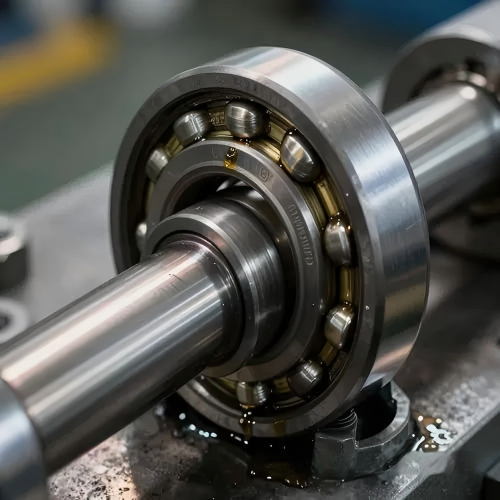
Proper greasing should follow the principle of "using the minimum amount necessary to ensure adequate lubrication." Generally, the grease fill volume should be kept between one-third and one-half of the bearing's internal free space; for high-speed precision equipment, this ratio should be reduced to 20%–30%. When replenishing grease, one can use the empirical formula G = 0.005 × D × B (where G is the replenishment amount, D is the bearing outer diameter, and B is the bearing width, all in millimeters) for precise calculation, adhering to a "little and often" approach—applying grease at regular intervals and in controlled quantities.
Myth 2: The "Grease Stew"—Blindly Mixing Products Leads to Disaster
In practice, for the sake of convenience, some personnel mix greases of different brands or types—a practice akin to feeding "poison" to the bearing. Grease performance depends heavily on the composition of its thickener (e.g., lithium-based, calcium-based, polyurea-based) and base oil. Mixing greases with different compositions can easily trigger chemical reactions that destroy the grease's structure.
Mixing incompatible greases can lead to unpredictable consequences, such as an abnormal drop in consistency, a lowered dropping point, excessive base oil separation, or hardening that clogs lubrication channels. This not only compromises the grease's original lubricating and extreme-pressure capabilities but may also generate corrosive substances, accelerating bearing wear and rust. Therefore, when changing grease, one must either thoroughly remove the old grease or strictly consult compatibility charts—avoiding any haphazard mixing of different products.
Misconception 3: A "one-size-fits-all" approach ignoring operating conditions; choosing the wrong grease renders the application useless.
Grease selection must match the equipment's specific operating conditions; otherwise, "replenishing" the grease can actually ruin the lubrication system. For instance, while molybdenum disulfide grease performs excellently under low-speed, heavy-load conditions, using it in high-speed bearings can cause its solid additives to increase frictional resistance, leading to abnormal temperature spikes. Similarly, failing to use a water-resistant lithium-based grease in humid environments makes bearings highly susceptible to rust, while ignoring the dropping point in high-temperature environments can cause the grease to rapidly lose effectiveness and leak away.
The correct approach involves a comprehensive assessment of operating temperature, load magnitude, and rotational speed. High-temperature conditions require synthetic greases with high dropping points; heavy-load applications call for extreme-pressure greases with low penetration (stiffer consistency) and high oil-film strength; and high-speed precision equipment requires specialized greases with low viscosity and low resistance.
Misconception 4: Rigid adherence to "fixed intervals" without scientific, dynamic monitoring.
Traditional maintenance models often mandate replenishing grease on a fixed schedule—such as once a year or once a month—but such rigid cycles overlook the constantly changing operational environments of the equipment. Factors such as rotational speed, load, ambient temperature, and contamination levels directly influence the rate at which grease is consumed and degrades.
Scientific maintenance should be based on dynamic monitoring. Maintenance personnel should cultivate the habit of closely observing equipment performance: using industrial stethoscopes to listen for smooth bearing operation, employing infrared thermometers to ensure temperature rises remain within reasonable limits (typically 30–40°C above ambient temperature), and using vibration meters to assess vibration levels. Grease should be replenished or replaced promptly only when the lubricant turns black, the temperature rises abnormally, or unusual noises occur; this approach replaces reliance on "gut feeling" with data-driven insights, enabling precise maintenance.