How Do High-Temperature Bearings Withstand 500°C?
From: XingMao DATE: 2026/11/5 Hits: 30
How Do High-Temperature Bearings Withstand 500°C?
Have you ever experienced this? Equipment in your workshop stops working after only a few days—either the bearings seize up completely, or they start making a racket like a runaway train. When you take them apart, you find the steel balls have melted into a solid, fused lump. This isn’t a case of poor quality; it’s a case of using the wrong component! Standa...
Have you ever experienced this? Equipment in your workshop stops working after only a few days—either the bearings seize up completely, or they start making a racket like a runaway train. When you take them apart, you find the steel balls have melted into a solid, fused lump. This isn’t a case of poor quality; it’s a case of using the wrong component! Standard bearings are incredibly fragile in environments exceeding 200°C. In contrast, "high-temperature bearings"—the "tough guys" of the industrial world—can operate in extreme heat without breaking a sweat.
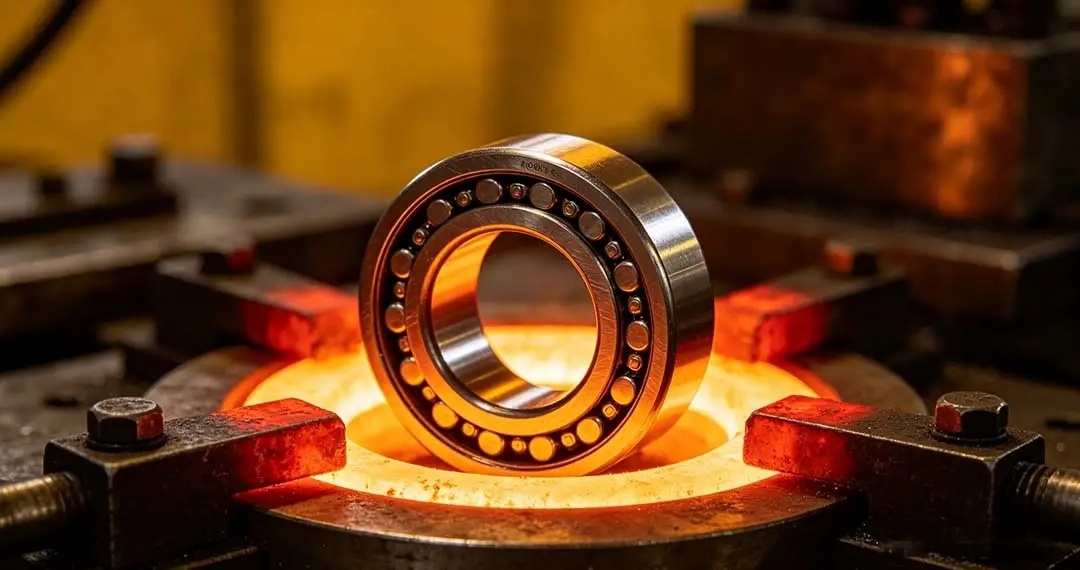
I. What Are High-Temperature Bearings, and How Do They Differ from Standard Ones?
Simply put, high-temperature bearings are specialized components "tailor-made" for high-heat environments. They are designed specifically to solve the three fatal issues that plague standard bearings under such conditions: softening, seizing, and lubrication failure.
What happens to standard bearings above 200°C?
Lubricating grease evaporates or carbonizes, leading to "dry friction." The hardness of the steel drops sharply, causing rapid wear on the balls and raceways. Thermal expansion causes internal clearances to vanish, resulting in the bearing "seizing up"—literally locking in place.
High-temperature bearings, however, are like bearings equipped with a "fireproof suit":
✅ Exceptional Dimensional Stability: They maintain precision even at high temperatures, with thermal deformation kept to the micron level.
✅ Sustained Hardness: Through the use of special materials and heat treatment, they retain a hardness of HRC58 or higher, even at 500°C.
✅ Advanced Lubrication: They utilize high-temperature-resistant grease or built-in solid lubricants, ensuring they won't "dry out" under heat.
✅ Additional Capabilities: Some models offer specialized features such as non-magnetic properties, corrosion resistance, and self-lubrication.
II. Which Applications Rely on These "Heat-Resistant Heroes"? It’s not just steelmaking furnaces that rely on these components—many other industrial processes depend on them to keep running:
Industry Sector | Typical Equipment | Temperature Range | Bearing Requirements
Metallurgy & Steel | Continuous casters, sintering machines, hot-rolling lines | 300–800°C | Thermal shock resistance, dust resistance, long service life
Construction Materials & Cement | Rotary kiln support rollers, grate coolers | 250–500°C | Ability to withstand both heavy loads and high temperatures
Glass & Ceramics | Glass furnaces, ceramic dryers | 400–600°C | High precision, corrosion resistance
Energy & Power | Boiler fans, steam turbines | 200–400°C | High speed, high temperature, vibration resistance
Emerging Industries | Photovoltaic annealing furnaces, lithium-ion battery sintering furnaces | 300–500°C | Cleanliness, corrosion resistance, long operational cycles
Real-world Case Study: At a steel mill, the sintering machine carts—originally equipped with standard copper-based bearings—required 34 repairs per month under 280°C operating conditions. After switching to high-temperature-resistant bearings, the maintenance interval was extended from 2 months to 6 months, resulting in a 60% reduction in maintenance costs! III. A Comprehensive Look at the "Family" of High-Temperature Bearings
Not all high-temperature bearings are the same; they fall into different "categories," each with its own unique strengths:
1. Standard Structural Types: The Best Value for Money
01. Self-aligning Ball Bearings (with pressed steel cages)
Temperature Range: -40°C to +300°C
Speed Limit: Suitable for long-term operation at speeds below 100 rpm
Features: Affordable; ideal for general high-temperature, light-load applications
02. Deep Groove Ball Bearings (full-complement design, without a cage)
Temperature Range: Around 300°C
Speed Limit: Below 200 rpm
Features: Simple structure with stable high-temperature performance; suitable for equipment operating at high temperatures and low speeds
2. Specialized Structural Types: Engineered for "Complex High-Temperature Challenges"
01. Solid-Lubricated Bearings (e.g., NSK’s SJ/YS series)
Core Technology: Uses solid lubricating materials as spacers, eliminating the need for liquid lubricants
Upper Temperature Limit: 230°C (for grease-lubricated types); can reach higher in vacuum environments
Applications: Vacuum furnaces and oil-free lubrication environments
02. Wide-Temperature-Range Bearings (e.g., SKF’s high-temperature series)
Temperature Range: -150°C to +350°C—capable of operating anywhere from the Antarctic to a volcanic crater
Special Design: Internal clearance is four times the standard C5 specification, preventing the bearing from "seizing" during cooling
Applications: Equipment subject to extreme temperature fluctuations
03. Hybrid Ceramic Bearings (featuring ceramic rolling elements)
Materials: Silicon nitride (Si₃N₄) ceramic balls paired with heat-resistant steel rings
Advantages: Lightweight, excellent thermal conductivity, and a low coefficient of thermal expansion; maintains rock-solid performance even at 500°C
Cost: 3–5 times more expensive than all-steel bearings, but with a service life more than 10 times longer
IV. Materials: The Key to "Heat Resistance"! Get to Know These "High-Tech" Materials
The heat resistance of high-temperature bearings depends entirely on the materials used. Here are some "heavy-duty" materials you should know about:
1. Specialty Bearing Steels: The "Iron Men" of High-Temperature Environments
01. Cr4Mo4V (M50) Steel: A Material Designed for Aero-Engines
Long-term temperature resistance: 315°C
Short-term limit: 430°C
Features: Maintains high hardness at elevated temperatures and offers excellent fatigue resistance; however, it comes at a premium price.
02. High-Sulfur Alloys: A Favorite in Steel Mills
Example: GLH-series bearing materials
Advantages: Offers three times the wear resistance of standard bearing steel in operating conditions between 280°C and 500°C, with built-in self-lubricating properties.
2. Ceramic Materials: The "Gold Standard" for High-Temperature Resistance
01. Silicon Nitride (Si₃N₄) Ceramics
Temperature resistance: 800°C+
Advantages: Lightweight (only 40% the weight of steel), low thermal expansion coefficient, non-magnetic, and corrosion-resistant.
Disadvantages: Highly brittle; susceptible to damage from severe impacts.
02. Zirconia (ZrO₂) Ceramics
Features: Offers better toughness than silicon nitride and superior impact resistance.
Ideal for: Applications that require both high-temperature resistance and impact resistance.
3. Solid Lubricants: The "Secret Weapon" for Operation Without Oil
In environments where conventional lubrication is impossible, these "self-sufficient" bearings get the job done:
Graphite + MoS₂ Composite Lubrication: Solid lubricants are embedded into a metal matrix, automatically releasing a lubricating film at high temperatures.
PTFE (Polytetrafluoroethylene) Coating: Features a low coefficient of friction; suitable for oil-free operation at temperatures up to 260°C.
Nickel-Based Self-Lubricating Alloys: Form a continuous lubricating layer at high temperatures; ideal for heavy-load, high-temperature scenarios.